Gujarat farmers ask for new GM crop traits as old cotton tech loses its edge
At a Wednesday workshop, growers said pests, erratic weather and rising costs have outpaced India's only approved GM crop, and asked for science-led rules.
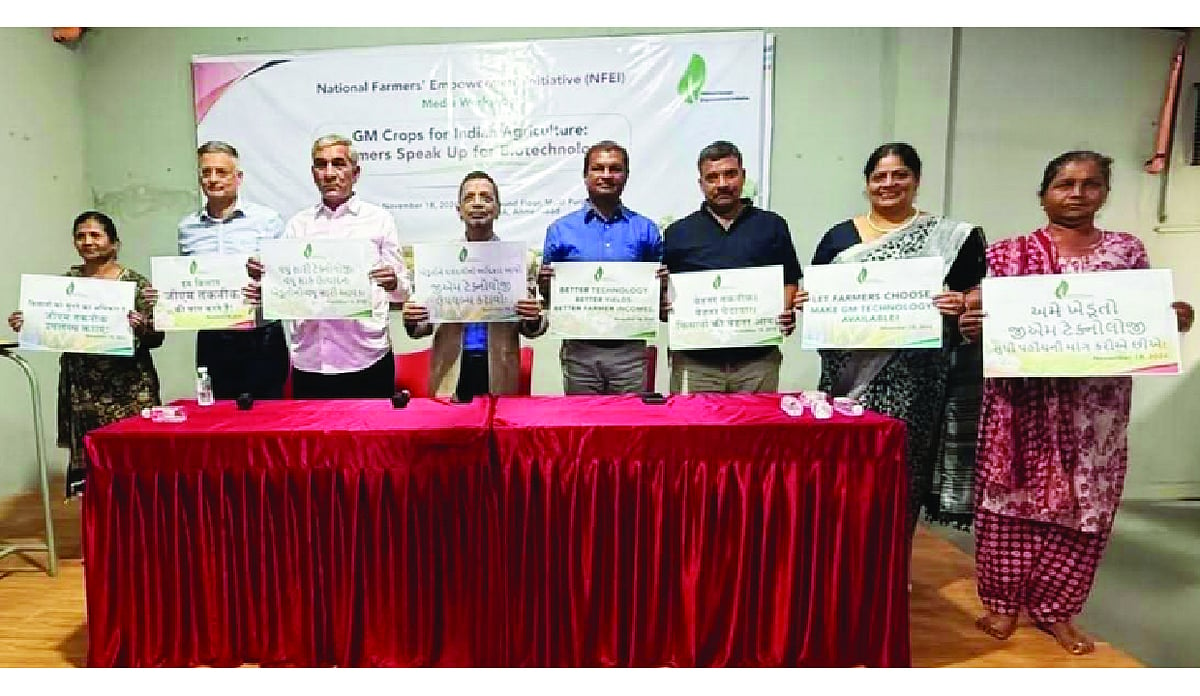
Farmers in Gujarat on Wednesday asked for access to the next generation of genetically modified (GM) crops and urged policymakers to let science guide decisions on farm technology. They spoke at a media workshop organised by the National Farmers Empowerment Initiative (NFEI), saying new pests, unpredictable weather and climbing costs call for better crop traits.
Gujarat was among the first states to plant Bt cotton after its 2002 approval. Ministry of Agriculture data cited at the event show national cotton yield rising from 186 kg per hectare in 2001-02 to 510 kg in 2013-14. India, a net importer of raw cotton until 2002, went on to become a leading exporter.
But the technology has not moved on. Bt cotton is still India's only commercially approved GM crop, and Bollgard II, introduced in 2006, remains the newest trait farmers can buy. Pink bollworm first got past single-gene Bt cotton in Gujarat in 2009 and has since developed resistance to Bollgard II as well. Globally, newer cotton traits combine protection against bollworms and sucking pests with tolerance to five herbicides.
"Bt cotton made a difference to cotton cultivation in India. Today, farmers face new pests, unpredictable weather and rising costs. We need access to improved technologies and better crop traits," said Prakash Punambhai Patel, a farmer from Simri village.
Dr Vijay Kumar, a former research scientist and head of cotton at Navsari Agricultural University, framed the issue as one of process. "The key question is not whether technology should be used, but how it can be assessed responsibly and deployed to meet the needs of Indian agriculture," he said.
Speakers named regulatory uncertainty as the main bottleneck. Bt brinjal was cleared in 2009 but has been under a moratorium since February 2010. GM mustard DMH-11 was recommended for environmental release in October 2022 and still awaits a decision after the Supreme Court delivered a split verdict in July 2024. Field trials also need a no-objection certificate from each state, and in 2023 Gujarat and Telangana declined trials of GE cotton hybrids designed to resist pink bollworm.
The workshop also pointed to the global picture. ISAAA's 2024 report on biotech crops says 218.71 million hectares were planted with GM crops that year, and 73 countries have adopted them since 1996, 44 through cultivation and 29 through imports. The World Health Organisation states that GM foods on international markets have passed safety assessments and are unlikely to pose risks to human health.
Read the original report: Gujarat farmers seek next generation of GM crops, urge science-led policy.