Modi at India-Asean Summit in Manila Pitches Maritime Plan, Free e-Visas
At the 23rd India-Asean Summit, the Prime Minister put forward a long-term maritime roadmap and a grab-bag of tech, youth and tourism offers, with China's Indo-Pacific footprint as the unspoken backdrop.
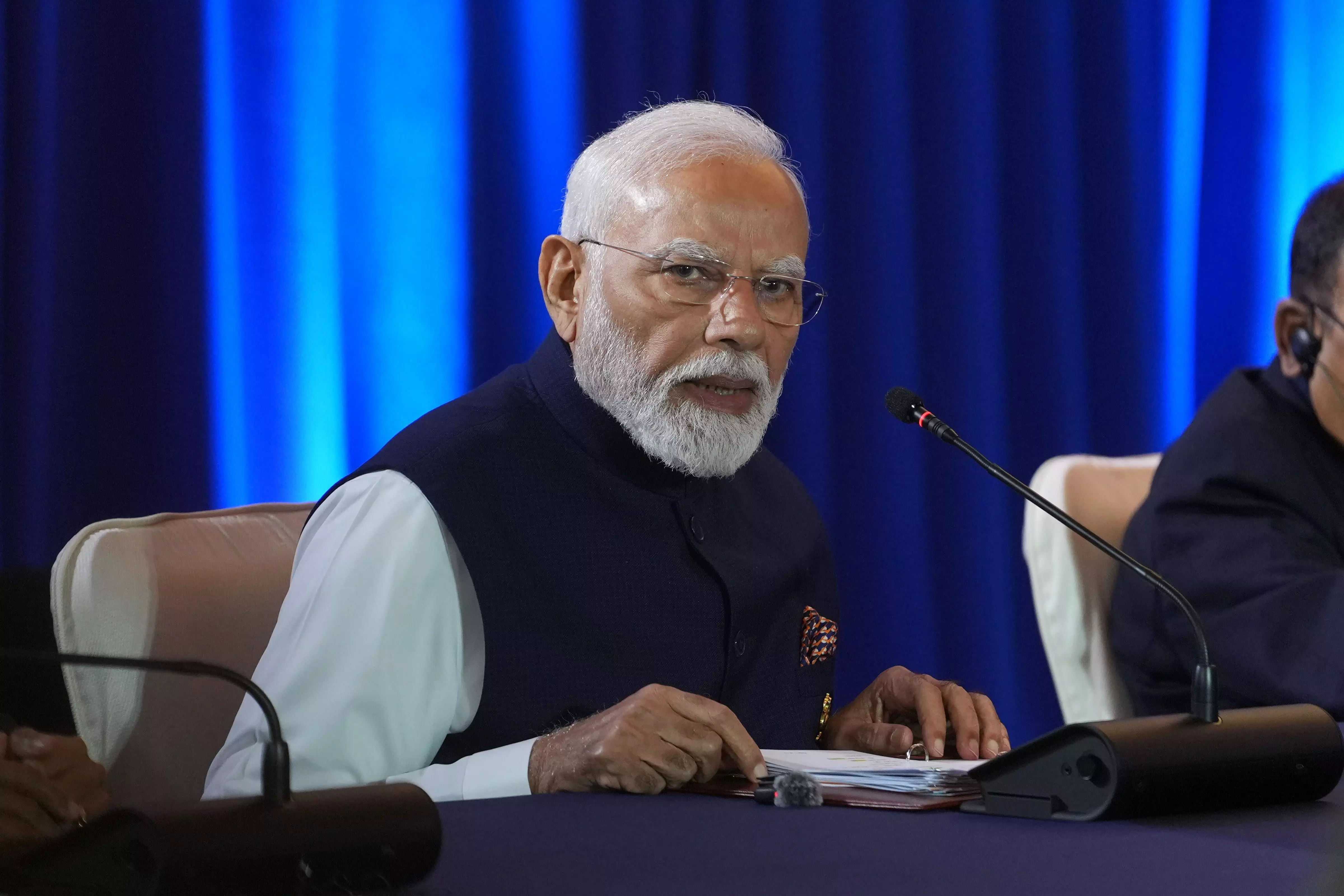
Prime Minister Narendra Modi used the 23rd India-Asean Summit in Manila on Tuesday to propose a long-term maritime cooperation plan with the ten-member bloc, spanning connectivity, scientific research, disaster management, Coast Guard cooperation, maritime domain awareness and the security of seafarers. Leaders also adopted a joint statement on disaster management.
The timing is hard to miss. With China's weight in the Indo-Pacific growing, a maritime framework that stresses awareness, coast guards and shared research is the kind of diplomacy that lets India signal strategic intent without naming anyone. Mr Modi himself kept to the language of cooperation, saying the region's future should be shaped "not by competition, but by cooperation", and reiterating India's support for Asean unity and centrality.
The disaster-management statement is the more concrete deliverable. It commits India and Asean members to regular training, simulation drills and exchanges of response personnel, including joint exercises. That is practical, low-friction cooperation among countries that share exposure to natural hazards, and it builds habits of working together that can matter well beyond a flood or cyclone.
Beyond the sea, the Prime Minister's list leaned on technology and resources: a joint cyber forensics training programme to build regional capacity, technical exchanges on nuclear energy, an Asean-India Space Hackathon, and cooperation on mining and critical minerals. Together they cast India as a provider of skills and a partner in supply chains, rather than only a market.
The soft-power section was just as busy. Mr Modi suggested free e-visas for tourists from Asean countries, an Asean-India Youth Connect initiative with youth summits, exchanges among young parliamentarians and start-up hackathons, expanded Asean scholarships at Nalanda University, and an Asean-India Creative Partnership Pavilion at Waves 2027. Whether the free e-visa idea becomes policy will depend on follow-through from New Delhi, as the proposal was announced rather than formalised.
He also offered a scorecard for the Act East Policy, launched in 2014: more than 100 people-to-people initiatives, nearly 250 Quick Impact Projects and over 10,000 skill-building scholarships, plus direct flights between India and nine Asean countries. Thanking Philippine President Ferdinand R. Marcos Jr. for the Asean chairmanship and for his role as India's country coordinator, Mr Modi noted this was his third visit to an Asean country this year. He pointed to 2027 as a milestone, marking 35 years of ties and five years of the comprehensive strategic partnership, and tied the Asean Community Vision 2045 to Viksit Bharat 2047.
The takeaway: the summit produced more proposals than signed commitments, but the pattern is clear. India is bundling security, technology and people-to-people offers into one package aimed at making itself a durable partner in Southeast Asia. Source: Deccan Chronicle.