Sachin Tendulkar Unveils 'Batography' at Wankhede, a Museum Tribute Told in 25 Bats
The MCA's new museum zone traces Tendulkar's life from a Kashmir willow bat at age five to his final Test innings, 13 years to the day after he retired.
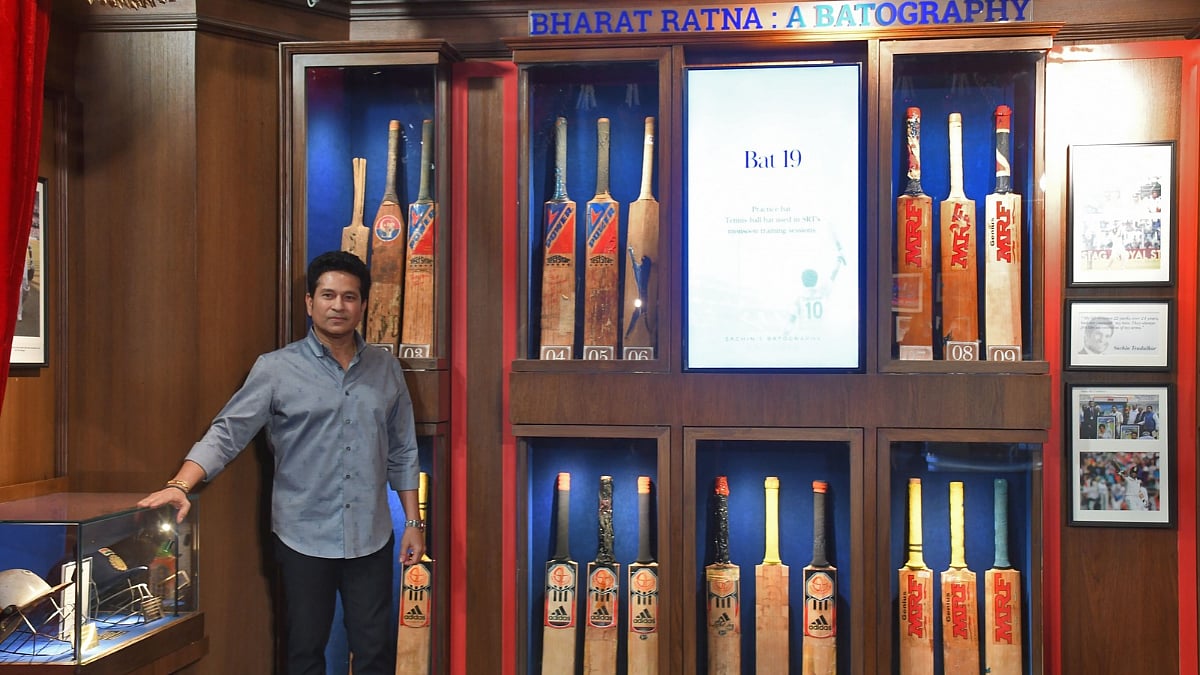
Sachin Tendulkar on Monday unveiled 'Batography', a new section of the MCA Sharad Pawar Cricket Museum at Mumbai's Wankhede Stadium, built around 25 bats from his career between 1978 and 2013. The Mumbai Cricket Association (MCA) chose November 16 deliberately: it is 13 years since Tendulkar played his 200th and last Test at the same ground.
The idea is simple and neat. Instead of a timeline of scorecards, each bat serves as a chapter. The display opens with the Kashmir willow bat his elder sister Savita gave him when he was five, and ends with the bat from his final Test innings.
In between sit some of the best-known tools of his trade: the bat from his maiden Test century at Manchester in 1990, when he was 17; one gifted by Sir Donald Bradman in 1998; the bat from the 2003 World Cup, where he was Player of the Tournament; and the one he used for his 100th international century against Bangladesh in Mirpur in March 2012.
Beyond the willow, there is personal memorabilia: his first helmet, a Mumbai Ranji Trophy jersey, the India shirt and helmet from his farewell Test, and the sheet of paper he read from during his farewell speech at Wankhede.
Tendulkar, joined by his family, said the bats were a constant through 24 years of cricket, feeling like an extension of his arms and each recalling a dressing room, a pitch or a crowd's roar. MCA president Ajinkya Naik called the exhibit a tribute to a phenomenon.
There is a practical hook for visitors too. Naik said more than 23,000 people have taken the MCA museum and stadium tour in the year since it launched, billed as India's first of its kind, and the new zone gives fans another reason to book. The launch was followed by a felicitation for Tendulkar and a fireside chat.
For fans, it is a rare chance to see the gear behind the milestones in the ground where, as a 10-year-old in 1983, Tendulkar first watched a Test and saw Vivian Richards make a century. Source: Free Press Journal.