Sir Syed Ahmed Khan's politics is being misread today, argues Chennai academic
A university teacher says the 19th-century reformer's ideas on Muslim identity are being judged through today's majority-minority lens, and he wants that changed.
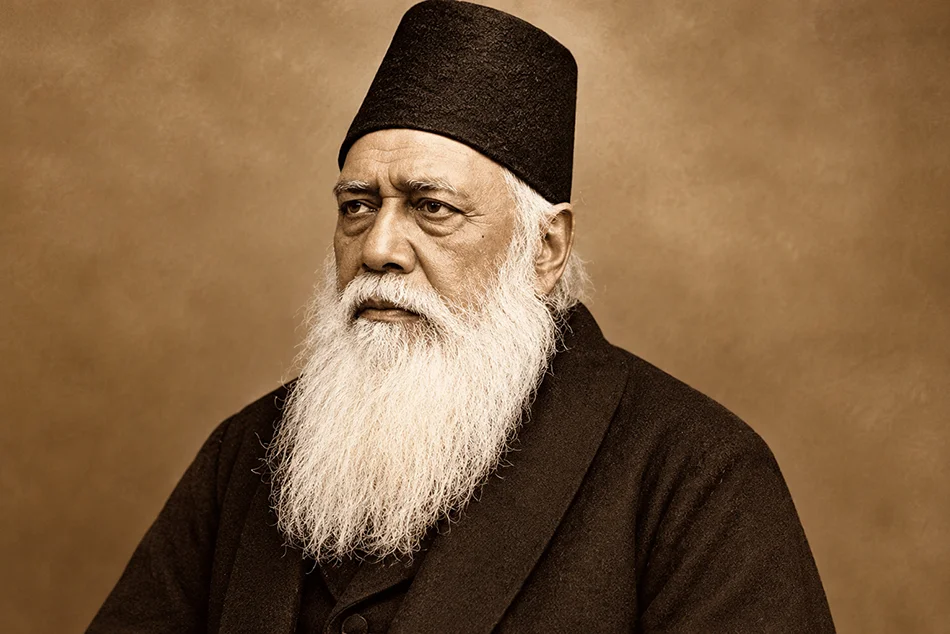
A political science lecturer at a private university in Chennai has argued that Sir Syed Ahmed Khan, the 19th-century educationist and reformer, is being badly misread in India today. Writing in a personal capacity, Dr Syed Ali Mujtaba says Sir Syed's words on Hindu-Muslim relations and Muslim political identity are now being pulled out of context and treated as proof of separatism.
The writer teaches a paper called 'Modern Indian political thinkers' to undergraduates, and he says the way the syllabus presents Sir Syed is part of the problem. According to him, some course material labels Sir Syed the first separatist Muslim leader and treats him as an early supporter of separate electorates, the Two-Nation Theory and, eventually, Pakistan. He says he is uneasy with that framing and has taught it with reservations.
Take his famous line comparing Hindus and Muslims to the two eyes of a beautiful bride. Mujtaba says that image is now read as a sign of division, when Sir Syed was actually pushing for harmony. Similarly, his argument that Muslims needed their own representation to advance socially and educationally is, in the writer's view, being condemned without any real look at the historical situation he was addressing.
The core of his point is timing. Sir Syed was born in 1817 and died in 1898, long before elected democracy and the modern majority-minority debate took shape under colonial rule. Mujtaba says Sir Syed could not have been thinking about separate electorates in a democratic system, that he had no real link to the Two-Nation Theory, and that Pakistan only entered public debate after the Lahore Resolution of March 23, 1940, decades after his death.
The writer also ties this to a wider problem he sees in Indian politics. When Muslims organise under their own leadership, he says, they are quickly labelled communal. When they join broader alliances in the name of secularism, they are often expected to fade into the background and give up a distinct political voice. He describes this as a trap that leaves Muslims with little room to be heard on their own terms.
Mujtaba's conclusion is a question he thinks the country needs to answer. Does a politics led by Muslims automatically count as communal, or should it be judged by its commitment to the Constitution? He says Sir Syed wanted a distinct identity for Muslims but not in separatist terms, and that his vision was one of unity in diversity. Whether one agrees with the writer or not, the debate shows how a 19th-century reformer's words can become a battleground in today's politics.
You can read the full opinion piece here: Sir Syed Ahmed Khan's political thoughts are misinterpreted.