Trump holds up India's 7% growth to attack Fed rates, claims US could hit 20%
The US president's comparison with India sidesteps how differently the two economies work, and arrives as inflation remains above the Fed's target.
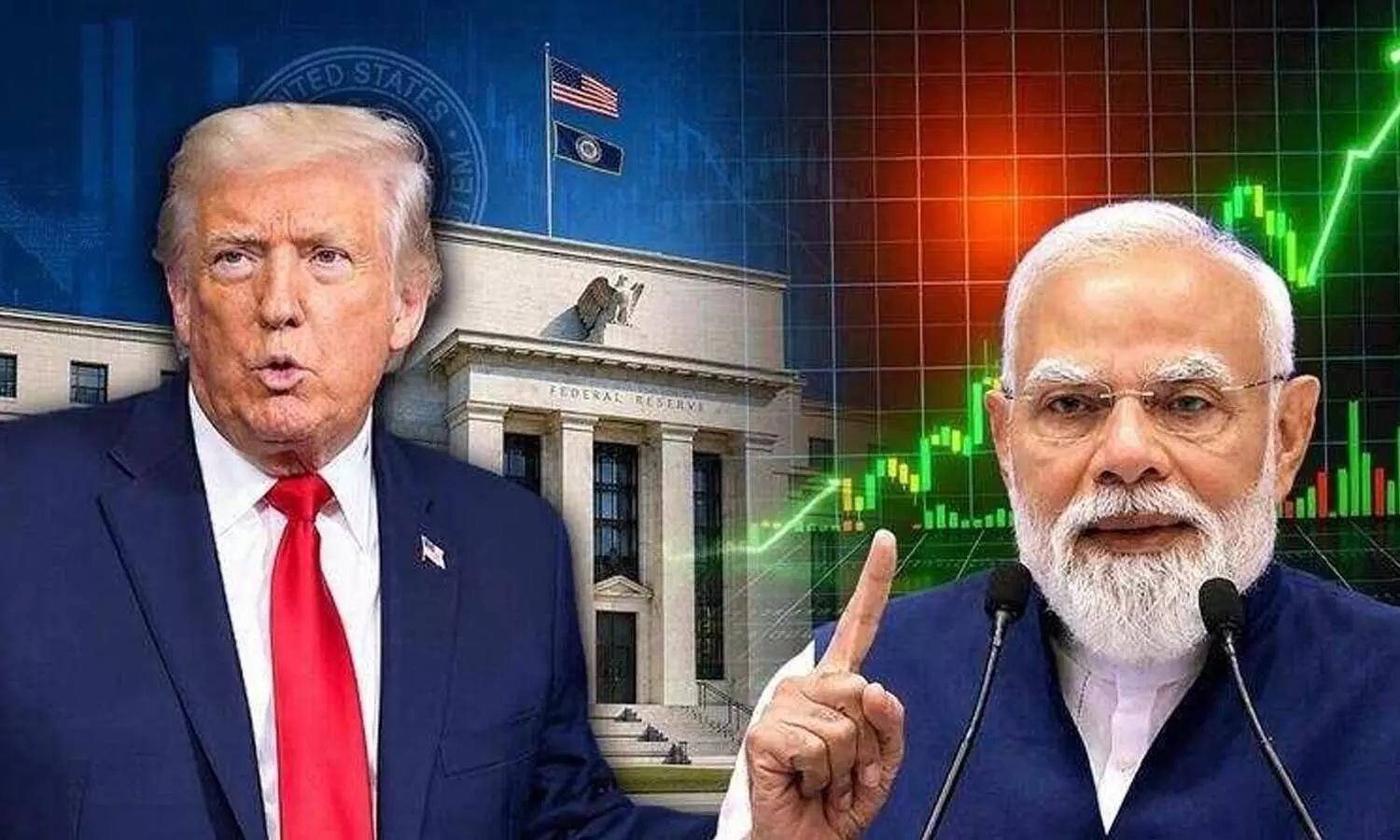
US President Donald Trump cited India's roughly 7 per cent GDP growth at the White House while attacking the Federal Reserve's interest rate policy. He said the United States could grow at 14, 15 or even 20 per cent if borrowing costs were lower. "If you look at India, they have low interest rates, and they have a 7 per cent GDP," he said, calling it "a sad thing" that the Fed raises rates when the economy is doing well.
The comparison is rhetorically convenient but analytically thin. India's growth is usually attributed by economists to a young workforce, a lower income base from which expansion comes faster, rising public capital spending and a large domestic market. Interest rates are one input among many. Growth of 14 to 20 per cent would also be far outside the US historical record in peacetime, and Trump offered no model or evidence for how rate cuts alone could deliver it.
The remarks come as Trump escalates pressure on the central bank at a moment when inflation is still above its 2 per cent goal. According to the figures cited in the report, annual PCE inflation stood at 3.6 per cent in September, with core PCE, which excludes food and energy, at 3.1 per cent. Those readings are the main constraint on any quick easing: cutting rates while price growth runs well above target risks reigniting inflation, which is the trade-off the Fed's critics rarely address.
Trump also warned that US technology companies building AI data centres abroad could face a "tremendous tax". He gave no detail on how such a levy would be designed or applied, and the report said he had not discussed it with administration officials. Without a mechanism, it is a signal of intent rather than policy, but it points to how the White House may try to steer where AI infrastructure investment is located.
The report also said Trump wants Jensen Huang to get a second chance to lead Nvidia, while noting that reports indicated the company's board was not considering reinstating him. That account is difficult to reconcile with Huang's public standing at the company, and readers should treat it with caution until clarified by Nvidia or the White House.
For India, the mention is mostly symbolic: a US president using its growth as a benchmark. The substantive question is whether Washington's pressure on the Fed alters the rate path, because US rate settings affect global capital flows, the rupee and emerging-market borrowing costs. Any shift in the Fed's stance would ripple through those channels regardless of how India's growth is characterised in speeches.
Source reporting: The Hans India.